
There is a familiar pattern playing out in nearly every organization right now. Leadership buys the AI tools, announces the AI strategy, and then issues the directive: everyone needs to be AI-ready. I liken this to handing out a box full of hammers and just telling everyone to pound on anything that might be a nail. It is the same move I have complained about before with innovation — telling people to “be more innovative” without giving them a process, or, as I once put it, refusing to invest in accounting while telling employees to be more accountable. We are doing it again, only the stakes are higher and the anxiety is louder.
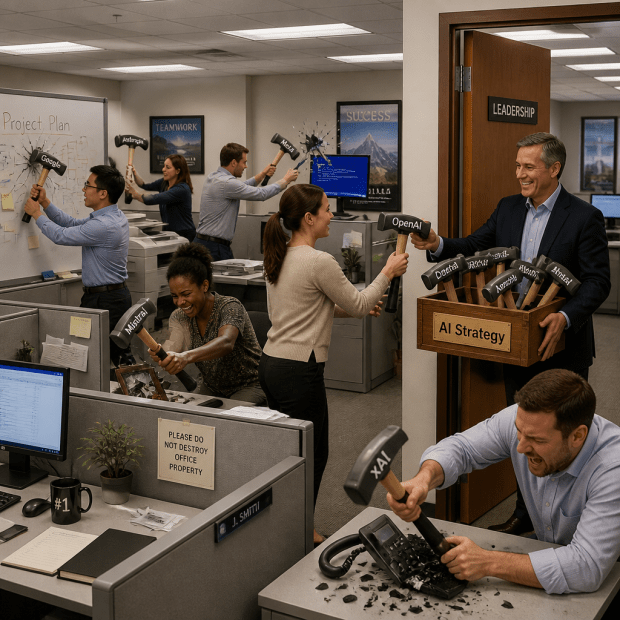
Here is the uncomfortable truth: the risk to your workforce is not AI. The risk is reacting to AI without ever understanding the actual work your people do. When organizations skip that step, the predictable results follow — skill obsolescence, quiet resistance to the very tools you just paid for, fear-based disengagement, a dip in productivity right when you need it least, attrition of the people you most wanted to keep, and a disappointing return on a very expensive investment. None of those are AI problems. They are omission problems; they are leadership problems.
So before we hand out the box of AI hammers and start telling everyone to start “banging” on everything they see, let’s do the thing almost no one wants to do. Let’s look at the work.
Start With Tasks, Not Tools
A “job” is a convenient label, but it is not the unit of analysis that matters. Jobs are bundles of tasks, and AI does not consume jobs whole—it acts on tasks. That distinction changes everything about how you plan.
The honest starting point is an old, unglamorous discipline: job-task analysis. Have the people who actually do the work inventory their tasks and estimate where their time goes. Then interrogate each task along a couple of dimensions that turn out to matter enormously in an AI context:
If you spend any time researching the best tools to classify tasks in relation to AI incursion you will generally see two dimensions: “Routine” versus “Non-Routine”; and “Operational” versus “Cognitive” or some similar construct that breaks down into:
- How scripted is it? Some tasks follow a procedure that rarely varies. Others require judgment, adaptation, and reasoning in the moment; versus,
- How human is it? Does the task need human oversight before anything goes out the door? Does it depend on empathy, trust, or persuasion? What are the consequences if it goes wrong?
What you may not see often is adding another dimension of what we frequently call “criticality”; i.e., how important is it that the task be done correctly the first time, every time? Maybe, one day, we will have the confidence level that AI solutions are infallible and 100% trustworthy; until then, it is a good idea to use criticality as a way to classify risk.
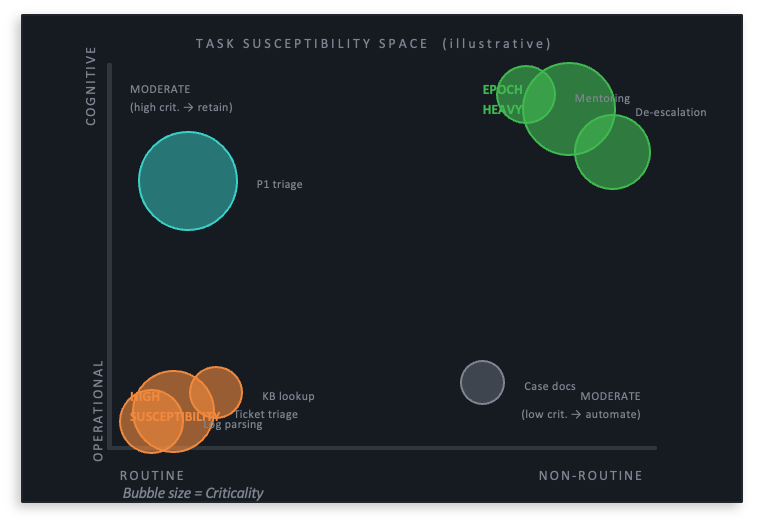
When you graph the results you get a fair idea of which tasks are best suited for AI (Operational and Routine), which tasks may be less suited (Cognitive and Non-Routine), and which tasks fall somewhere between. When you add criticality, and time studies, you have a clear view of the tasks that exist today as well as the potential ROI and risks of automating these tasks.
Notice that none of this requires you to predict the future of AI. It requires you to understand the present of the work. That is a far more tractable problem, and it is the foundation everything else sits on.
Every Task Has One of Four Futures
Once you can see the work at the task level, you can ask the question everyone is actually afraid of — but ask it precisely. For each task, what is AI most likely to do?
- Automate it. The task largely goes away or runs with minimal human involvement.
- Augment it. A human still owns the task, but does it faster, better, or at greater scale with AI assistance.
- Leave it human-owned. Judgment, trust, accountability, and consequence keep the task firmly with a person.
- Make it more important. This is the category people forget, and it may be the most strategically interesting. AI raises the value of certain human work — the oversight, the relationship, the critical judgment — precisely because so much else around it is being automated.
That fourth category is the antidote to fear, because it re-frames the whole conversation. AI is not just subtracting from the role; it is reshaping it, and parts of it are about to matter more. People can move toward that future. They cannot move toward a vague mandate to “be ready.” Involving the people who do these tasks to understand where they fall, and sharing the results with them can go a long way to overcoming fear and resistance.
Three Dimensions of “Ready”
When you aggregate those task ratings back up, capability sorts itself into three buckets worth developing deliberately:
- Hard skills — the technical capabilities that come out of the operational, more scripted tasks.
- Soft skills — the interpersonal and cognitive capabilities that cluster around the non-routine, human-owned work.
- AI literacy — the emerging baseline, drawn from wherever AI tooling is already showing up in the work.
This is where most “AI training” goes wrong. It treats AI literacy as the only skill that matters and bolts a tool tutorial onto everyone’s calendar. But if the susceptibility analysis tells you a role’s future value is concentrated in human-owned judgment and the relationships around it, then the highest-leverage up-skilling might be in the soft-skill column, not the prompt-engineering one.
Readiness Is a Human State, Not a Technical One
Here is the part the technologists tend to miss, and the part my own work on expertise keeps dragging me back to: you cannot up-skill a workforce that is frightened, demoralized, or quietly convinced you are training their replacement for them.
So before any intervention, take a baseline of the human reality, not just the skill gap. What is people’s actual confidence? Their learning agility? Their sense of preparedness? Where are the human-premium skills already strong? And — say it plainly — where are the resistance and fear indicators? Measure that the way you would measure anything you intend to manage. Pair the self-assessment with open-ended questions and a few real conversations, because the numbers will tell you what and the words will tell you why.
If that sounds like an assessment problem, it is — and I would argue it should be treated with the same seriousness as any psychometric instrument. Done casually, you get vibes. Done with attention to what you are actually measuring, you get a defensible map of where your people are and what they need. That is the difference between a program and a slideshow.
Final Thoughts
The reflex of the moment is to treat AI as something that happens to a workforce. The better framing is that AI is something you can lead a workforce into — but only if you do the work of understanding the work. Analyze the tasks. Sort their futures honestly, including the ones that are about to matter more. Develop the right mix of hard skill, soft skill, and literacy. And take the human temperature before you prescribe anything.
AI does not reduce the need to understand how work gets done and how people develop capability. It raises it. The organizations that figure this out will not be the ones with the most tools, they will be the ones who continue to thrive.
If this resonated, I write regularly about strategy, innovation, assessment, and the future of work at The Versatilist Perspective.

